

Your Nervous System Was Only Trying to Protect You
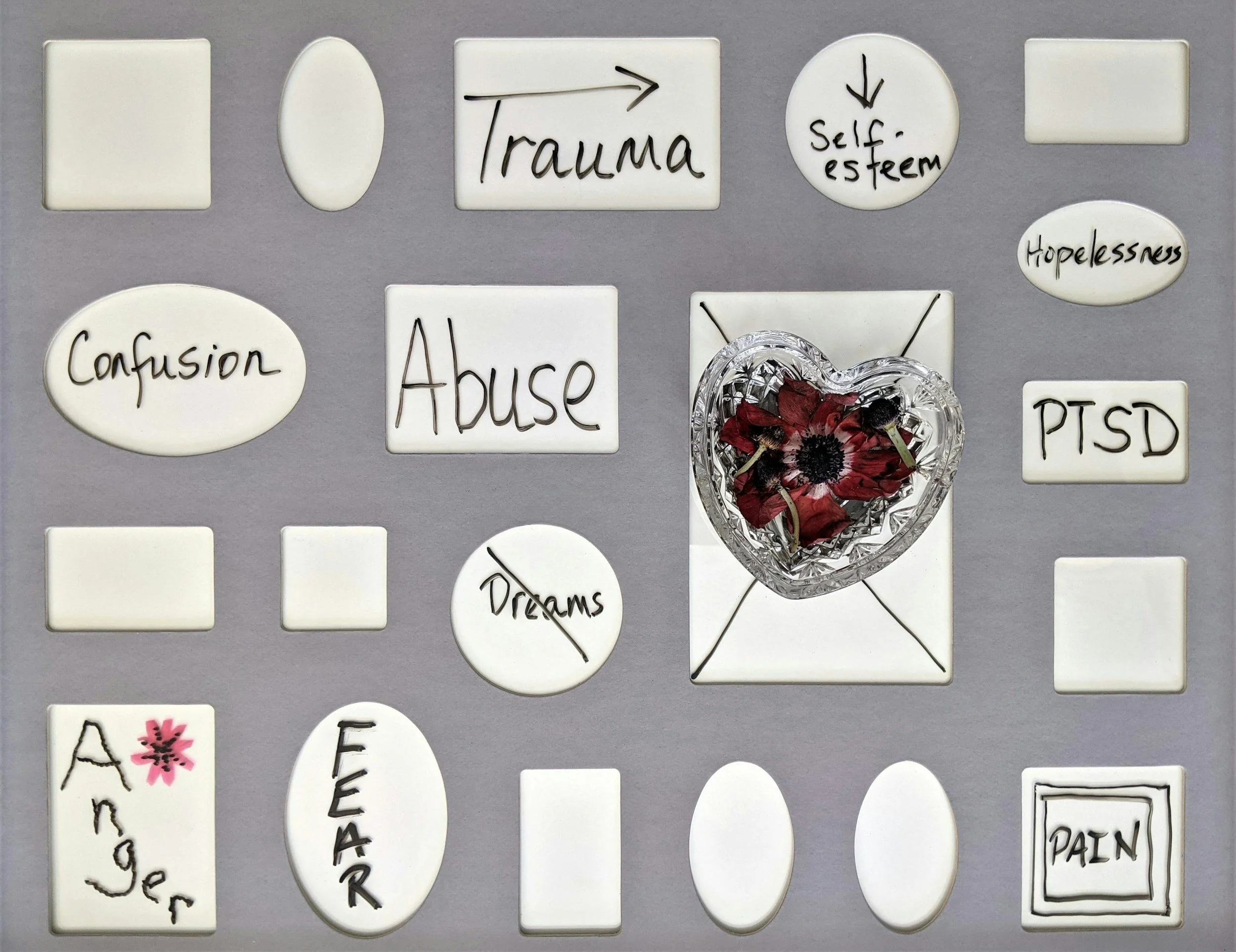
Have you experienced these?
I want to start with the gentlest thing I know how to say: if you continue to see patterns of lost friendships, lost jobs, abusive relationships, overachievement, addiction problems, these may be symptoms of trauma, PTSD, or both. The heaviness you carry is not a character flaw. It is not weakness, and it is not you being "too much" or "too sensitive." It is a body that learned, very early and very thoroughly, how to survive. And the same brilliance that kept you safe back then is often the thing that aches in you now. That is not failure. That is biology doing exactly what it was asked to do.
Trauma, complex trauma, or complex PTSD, is what can grow out of harm that is not a single event but a long season. It tends to come from things that repeated, things that happened in childhood, things that unfolded inside the very relationships that were supposed to keep you safe. And because it lived in your body for so long, it does not always look like flashbacks and obvious fear. Sometimes it looks like never feeling at ease or funny repeated patterns like Déjà vu. Sometimes it looks like working very hard to be good. Sometimes it looks like a quiet, bone-deep sense that a connection is not safe.
The body remembers what the mind tries to forget
There are some books that change your life. Reading this book has changed my understanding of suffering. In The Body Keeps the Score, Bessel van der Kolk gives us language for something a lot of survivors already feel in their skin: trauma is not just a story we remember, it is something the body holds. Long after the danger has passed, the nervous system can stay on high alert, scanning for threat, bracing for the next bad thing. Your heart races at a tone of voice. Your stomach drops at a closed door. You go numb in a moment that should feel ordinary.
What I find so freeing about his work is that it takes the shame out of these reactions. They are not you overreacting. They are an alarm system that got set during a time when the alarm was the only thing keeping you alive, and never got the message that the war is over. Van der Kolk is clear that this is why simply talking about trauma is often not enough. The body needs to learn, slowly and gently, that it is allowed to feel safe again.
In his groundbreaking work and his book written with Oprah Whinfrey, Dr. Bruce Perry in What Happened to You?, explains that this ability to dissassociate from trauma is the greatest survival mechanism of the human body. It is in dissassociation that we survive, but where the feelings inside never die. These feelings need rythm, processing, safety, and compassion to get out and heal.
You are not the only one who knows this in your bones
If van der Kolk gives us the science, Stephanie Foo gives us the lived experience of it. What My Bones Know is her memoir of healing from complex PTSD that began in childhood, and reading it can feel like being understood by someone who has been exactly where you are. She writes about the long shadow of growing up with abuse and abandonment, about the way that pain does not stay politely in the past but shapes how you love, how you work, how you trust.
What moves me most about her story is how she holds both the damage and the healing at once. She does not pretend it was tidy. She also does not pretend it was impossible. And she gently insists on something we do not talk about enough: that trauma is not only personal. It can be cultural and it can be inherited, carried quietly across generations and shaped by the silences a family or a community keeps. If your trauma has roots that reach back further than your own childhood, you are not imagining it.
Your ACE score is a doorway, not a verdict
You may have heard of the ACE score. ACE stands for Adverse Childhood Experiences, and the original study, which came out of work by researchers at the CDC and Kaiser Permanente in the 1990s, asked a simple, devastating question: what happens to us, long-term, when childhood is hard? The answer was striking. The more adversity someone experienced before the age of eighteen, the higher their risk later in life for a whole range of physical and mental health struggles.
The test itself is short. It asks about things like abuse, neglect, and growing up around addiction, mental illness, violence, or the loss of a parent. You can take it for yourself through this thoughtful piece from NPR, which walks you through what your number means and, just as importantly, what it does not: Take the ACE quiz, and learn what it does and doesn't mean.
I want to be honest with you about this tool, because honesty is its own kind of care. The original ACE study was powerful, but the group it studied was fairly narrow, mostly white, middle-class, and insured. That matters. It means the original ten questions do not fully capture the kinds of adversity that shape so many lives, like racism, poverty, community violence, or the weight of being an immigrant or a child of immigrants. This is part of why researchers later expanded the measure to include these community and cultural realities, so the score could speak to more of us more truthfully. So please hold your number gently. It does not measure your worth, it does not predict your future, and it does not count the love and resilience that also lived in your story. Think of it less as a diagnosis and more as a doorway, a way of saying, oh, this is why my nervous system learned what it learned.
Hyperarousal and hypoarousal, two sides of the same coin
This is where the work of Dan Siegel becomes so tender and so useful. In The Developing Mind, he shows how our capacity to handle our own feelings is not something we are simply born with. It is built, in large part, through our earliest relationships. A baby who is soothed learns, in their very nervous system, that big feelings can be survived and that other people can help. A child who is left alone in their distress, or frightened by the very people meant to comfort them, learns something else entirely.
Siegel gives us a beautiful idea called the window of tolerance. Picture a zone in the middle where you feel settled enough to think clearly, to be present, to connect. Inside that window, life feels manageable. The trouble with trauma is that it narrows the window, so the smallest things can knock you out of it.
And here is the part I most want you to hold onto. When you get pushed out of that window, it can go in two directions, and they are two sides of the same coin. One direction is hyperarousal: your system floods, you feel anxious, panicky, irritable, your thoughts race, your body wants to fight or flee. The other direction is hypoarousal: your system shuts down, you feel numb, foggy, exhausted, disconnected, frozen, like the lights are on but no one is home. They look like opposites. They are not. They are both your nervous system doing the same thing, which is trying desperately to protect you when it senses you have left the zone of safety. If you swing between feeling like too much and feeling like nothing at all, you are not broken. You are dysregulated, and dysregulation can be healed.
In my clinic, I have found neurofeedback to be the fastest way to expand the window of tolerance and to expand functioning and nervous system resiliance.
We learn our scores so we can teach our bodies something new
Here is the hope, and it is real hope, grounded in how brains actually work. The nervous system that learned fear can also learn safety. This is the quiet promise running underneath all of this work. Van der Kolk points to it, Foo lives it, and Siegel explains why it is possible: the brain stays changeable across our whole lives, especially in the presence of safe, attuned relationships.
So we do not learn our ACE scores to feel defined by them. We learn them so we can finally understand the language our bodies have been speaking all along, and then begin, patiently, to teach them something new. We learn to notice when we have slipped out of our window, and to name it without shame. We learn that we can come back, often with the help of another regulated nervous system, because so much of healing happens in connection. We learned to feel unsafe in relationship, and it turns out that much of how we heal is in relationship too, with people who are gentle, consistent, and safe.
If you take nothing else from this, take this: your reactions made sense in the past, but adaptive them, often means maladative now. We need to train our CNS out of these patterns and back into safety. So, the very same nervous system that learned to brace for harm is capable, with time and tenderness and support, of learning to rest in safety, in steadiness, and in the kind of close, trusting connection you have always deserved.
A gentle note: this piece is meant to offer understanding and hope, not to replace care. Complex trauma deserves real support, and you do not have to do this alone. If any of this resonated, please consider reaching out to a trauma-informed therapist who can walk alongside you. You are worth that kind of care.
References
Felitti, V. J., Anda, R. F., Nordenberg, D., Williamson, D. F., Spitz, A. M., Edwards, V., Koss, M. P., & Marks, J. S. (1998). Relationship of childhood abuse and household dysfunction to many of the leading causes of death in adults: The adverse childhood experiences (ACE) study. American Journal of Preventive Medicine, 14(4), 245-258.
Foo, S. (2022). What my bones know: A memoir of healing from complex trauma. Ballantine Books.
Perry, B. D., & Winfrey, O. (2021). What happened to you? Conversations on trauma, resilience, and healing. Flatiron Books.
Siegel, D. J. (2012). The developing mind: How relationships and the brain interact to shape who we are (2nd ed.). Guilford Press.
Starecheski, L. (2015, March 2). Take the ACE quiz, and learn what it does and doesn't mean. NPR. https://www.npr.org/sections/health-shots/2015/03/02/387007941/take-the-ace-quiz-and-learn-what-it-does-and-doesnt-mean
van der Kolk, B. A. (2014). The body keeps the score: Brain, mind, and body in the healing of trauma. Viking.
