
This weekend we turned the clocks back an hour. Here's why that matters more than you think, and what a Nobel Prize and further research tell us about light, the body clock and depression.
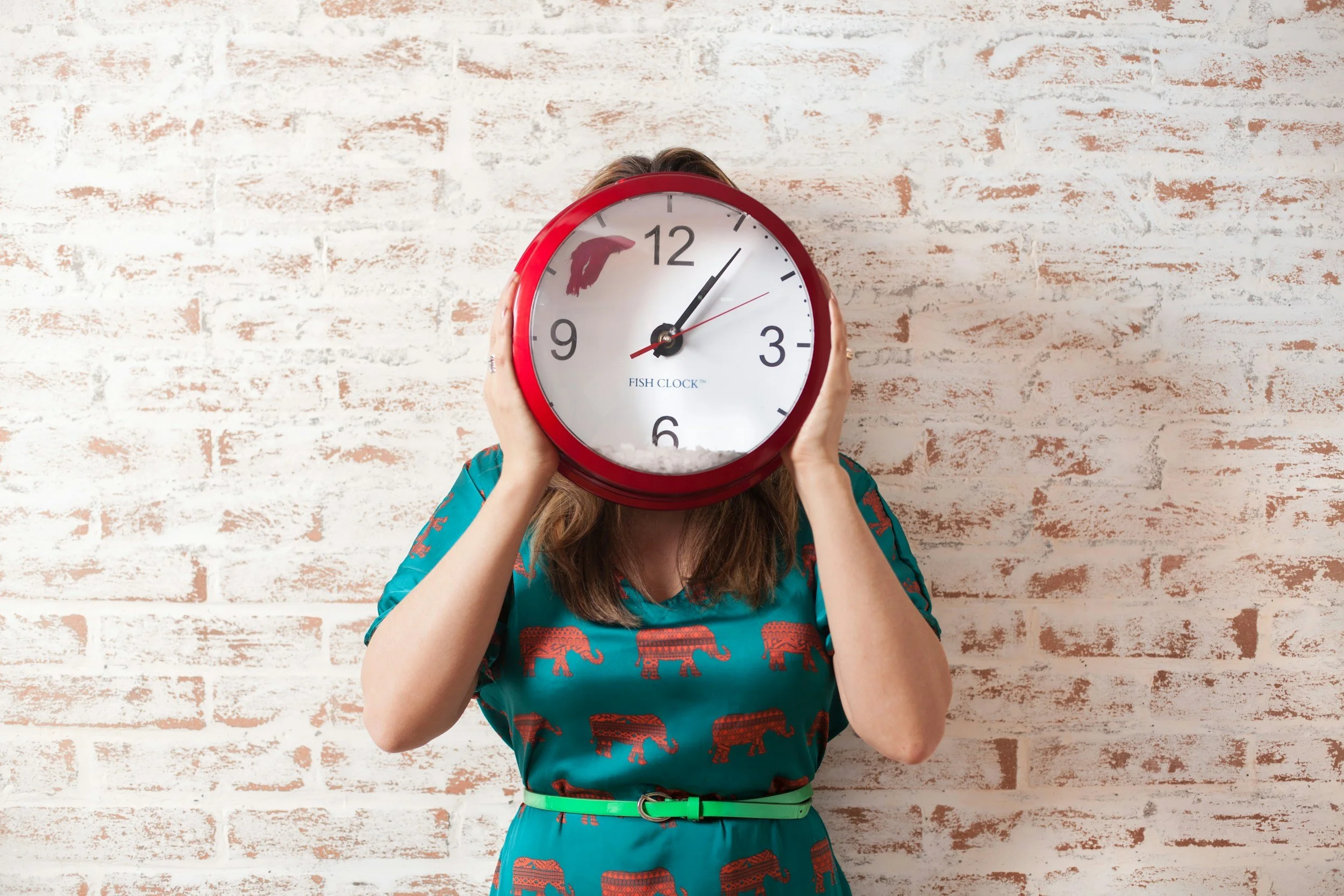
Your internal clock predicts your moods… Part 1 of a 2 part diolague.
This weekend, daylight saving time ended. At 2 a.m. on Sunday, the clocks fell back an hour, and just like that, the sun started setting an hour earlier. Most of us think of it as a bonus hour of sleep. This year, I see it very differently.
One hour sounds small. But your body doesn't run on the clock on the wall. It runs on an internal clock that is set by light, and on Sunday everything around that clock moved: work start times, school bells, dinner and bedtime.
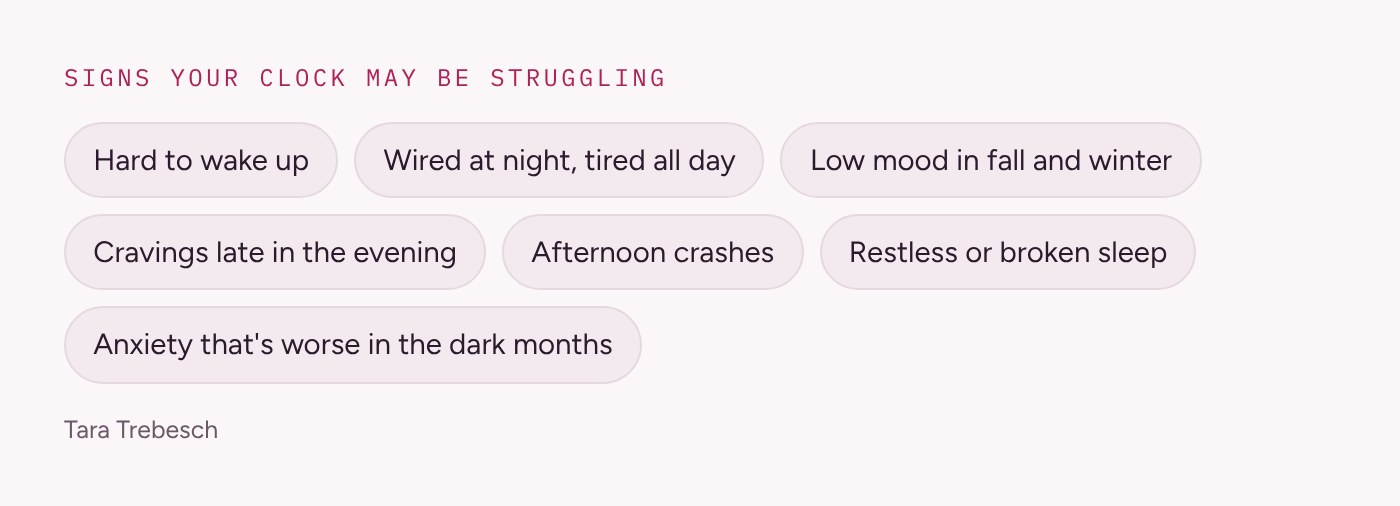
My recent reading of Dr. Satchin Panda's book, The Circadian Code, has me thinking about this year's change in a whole new way, especially as I sit with my patients. Every fall I hear the same thing. The days get shorter, and people tell me they feel flat, foggy, anxious or just "off." Most of them think it's a willpower problem. It usually isn't. Very often, it's a timing problem.
Dr. Panda points out that even one late night can be as disruptive as flying across a time zone, something he calls social jet lag (Panda, 2018). A time change is social jet lag for an entire country, all on the same night.
The hardest part of the time change is that it is not just you who has to adjust. As a wife and mother of young kids, we all have to adjust. Every member of the family has to adjust, even the dog who still wants breakfast at the old time. Panda describes how the family of a shift worker becomes a "secondhand shift worker," because one person's off-rhythm schedule pulls everyone else along with it. A house where everyone is adjusting to a new clock at a different speed looks like shift work. Cranky mornings, kids who can't fall asleep, snacking at odd hours, getting ill and short tempers are often clocks out of sync.
The effects run deeper than most people realize. Hawaii and most of Arizona skip the switch entirely, most countries in the world don't change their clocks at all, and whether the US should keep doing it comes up in Congress nearly every year.
Your body runs on a clock. When that clock gets the right signals, everything from your hormones to your gut to your mood shows up on time. When it doesn't, things start to drift. This two-part series is about that clock, and why I think it deserves a bigger place in how we talk about depression.
A Nobel Prize for the body's clock
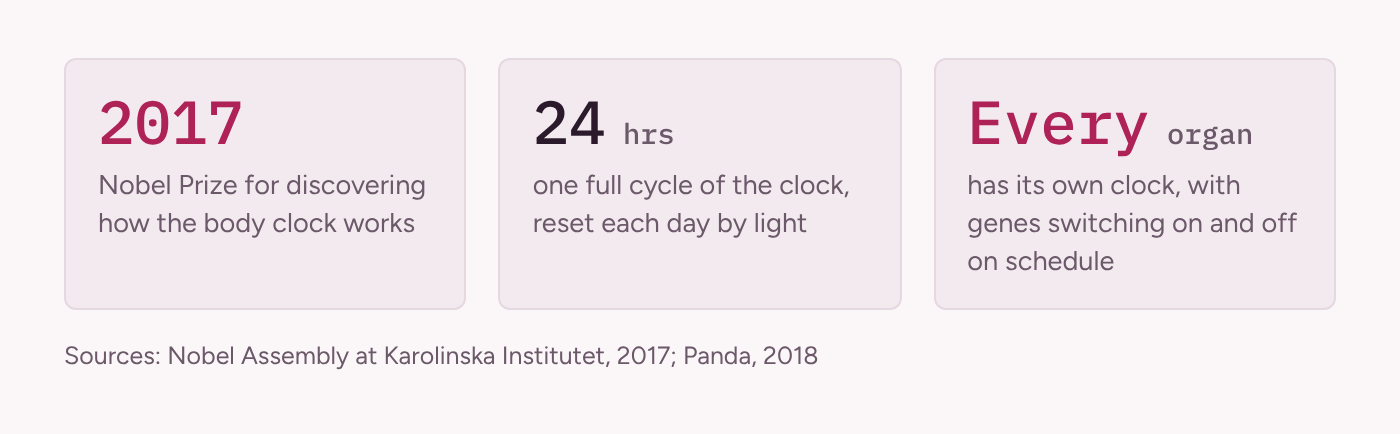
while we have lived on clocks all our lives, the understanding of the body’s clock is rather nacent. it was only in 2017 that Jeffrey Hall, Michael Rosbash and Michael Young won the Nobel Prize in Physiology or Medicine for figuring out how our internal clock actually works. Working with fruit flies, they found a gene called period. Later they found more pieces of the machine, genes called timeless and doubletime, that keep the cycle ticking (Nobel Assembly at Karolinska Institutet, 2017).
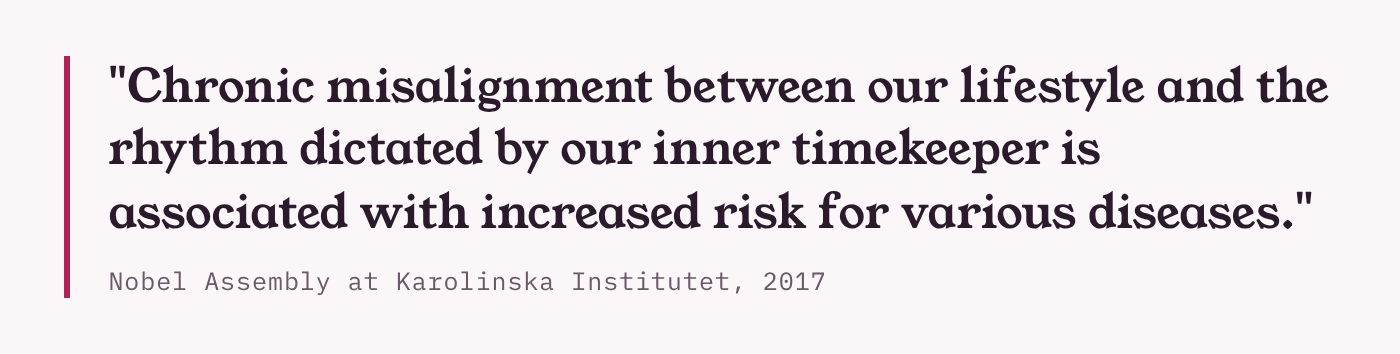
That might sound like a small, nerdy discovery about flies. It isn't. The same clockwork runs in our cells too. The Nobel committee put it plainly: the clock regulates "behavior, hormone levels, sleep, body temperature and metabolism," and a large share of our genes are controlled by it.
Everything in your body has a schedule
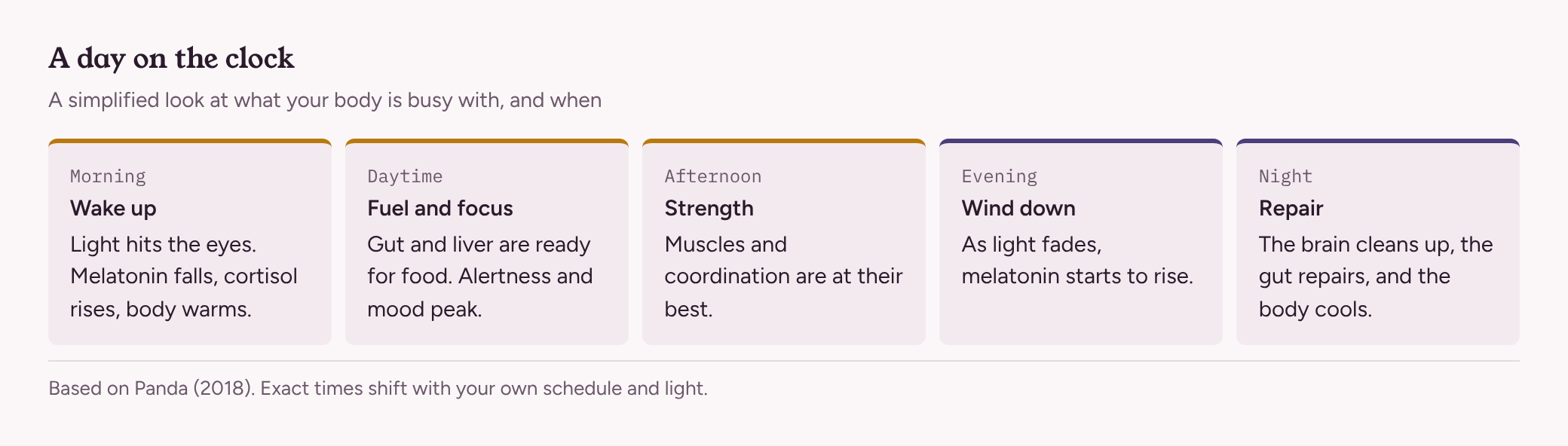
Dr. Panda, a researcher at the Salk Institute, has spent his career studying what this clock means for everyday health. I recently read his culmination of some of this work, The Circadian Code, where he explains that there is a master clock in the brain, and then a clock in nearly every organ: the liver, the gut, the muscles, the fat cells (Panda, 2018). In each one, thousands of genes switch on and off at different times of day, like a crew working in shifts.
Your liver expects food at certain hours. Your gut lining does its repair work during the overnight fast. Even your gut bacteria have daily rhythms, and Panda describes how eating late at night throws them off too. Metabolism, digestion, immunity and mood are all on the same timetable.
Light is the master switch
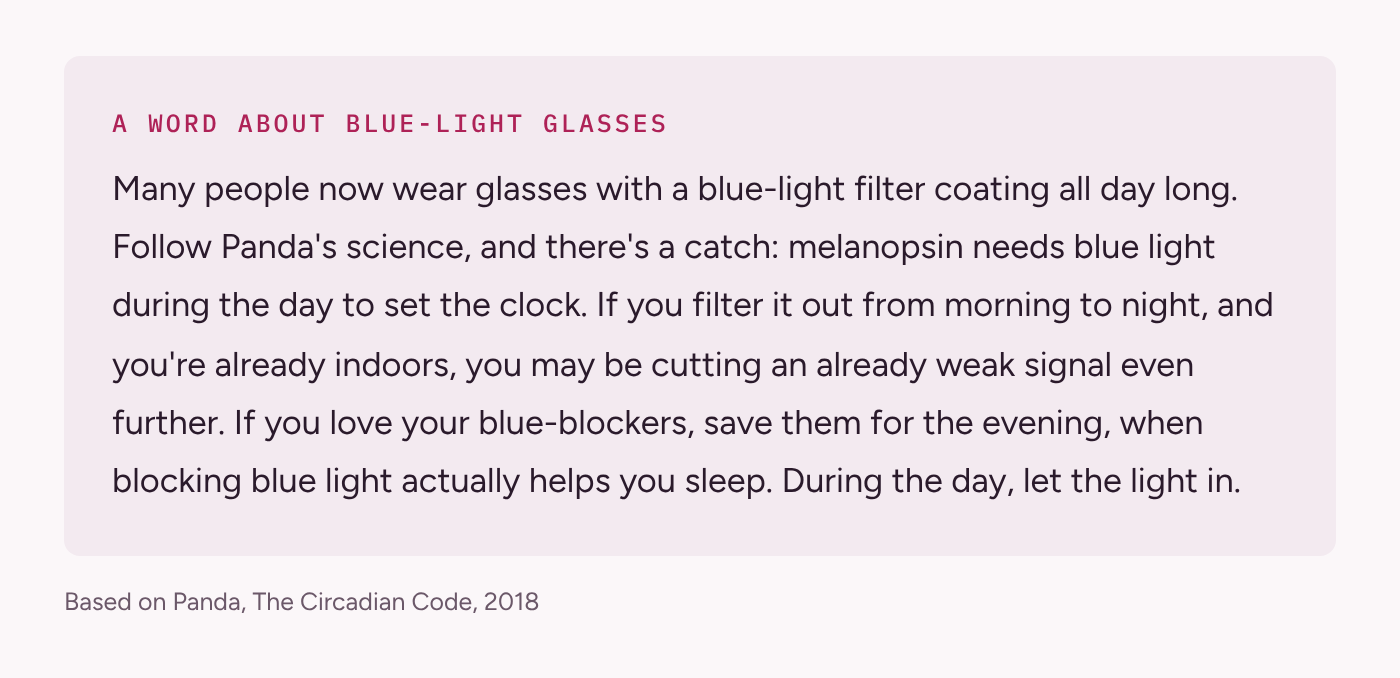
Here's the piece I find most important. Panda's lab helped uncover how a special light sensor in the eye, a protein called melanopsin, tells the brain's clock what time it is. It isn't about seeing. It's about measuring daylight. And it's most sensitive to blue light, the kind that's abundant in morning and midday sun.
So blue light during the day is a good thing. It's the signal that says "it's daytime, turn everything on." Blue light at night is the problem, because it tells the brain it's still daytime and holds back melatonin.
Dim days, low moods
Most of us now spend our days indoors. And indoor light, even in a bright office, is far dimmer than daylight. Panda writes that dim indoor light cannot fully activate melanopsin, so the clock never gets a clear "it's morning" message. We feel sleepy and less alert, and he notes that after a few days or weeks, this can slide into depression and anxiety (Panda, 2018).
Think about what that means for someone who works in a windowless or low-light building. They drive in before sunrise in winter, sit under dim light all day and drive home in the dark. Their brain may never get a real daytime signal. That's not a character flaw. That's biology.
What seasonal depression and anxiety may be telling you
I see seasonal affective disorder, and a lot of fall and winter anxiety, as a clue. If your mood drops as the days get shorter, your body is telling you something about yourself: you are sensitive to changes in light.
Some people sail through November. Others feel it in their bones. If you're in the second group, that's useful information. It means light isn't a nice extra for you. It's part of your mental health care, the same way sleep and food are. You'll want to be more intentional about getting it than the people around you.
Questions to sit with
How many minutes of real daylight did I get today, outside or by a window?
Does my mood shift with the seasons? Did it last year?
Is my workspace bright, or am I living in dim light most of the day?
Am I wearing blue-light filtering lenses during the day?
Is my bedroom truly dark at night?
Want help connecting the dots? My courses walk through sleep, light, metabolism and mood in plain language, with simple steps for real life.
This post is for education, not medical advice. If you're struggling with depression or anxiety, please reach out to your doctor or a mental health professional.
References
Nobel Assembly at Karolinska Institutet. (2017, October 2). The Nobel Prize in Physiology or Medicine 2017: Jeffrey C. Hall, Michael Rosbash and Michael W. Young [Press release]. nobelprize.org
Panda, S. (2018). The circadian code: Lose weight, supercharge your energy, and transform your health from morning to midnight. Rodale Books.
