
A question I've been chewing on all week, and one I'd love every parent to sit with too.
This week I've been sitting in on the Metabolic Psychiatry Summit, listening to doctors, researchers and families talk about how food and metabolism affect the brain. I came away even more convinced of something I see in my own practice every day: sugar and chronic inflammation sit at the root of a lot of what we call dis-ease, whether it shows up in the body or in the mind.
So let's talk about sugar and ADHD. Not to blame parents, and not to hand you a tidy answer. Just to look at the pieces together.
1 in 9 US kids have been diagnosed with ADHD
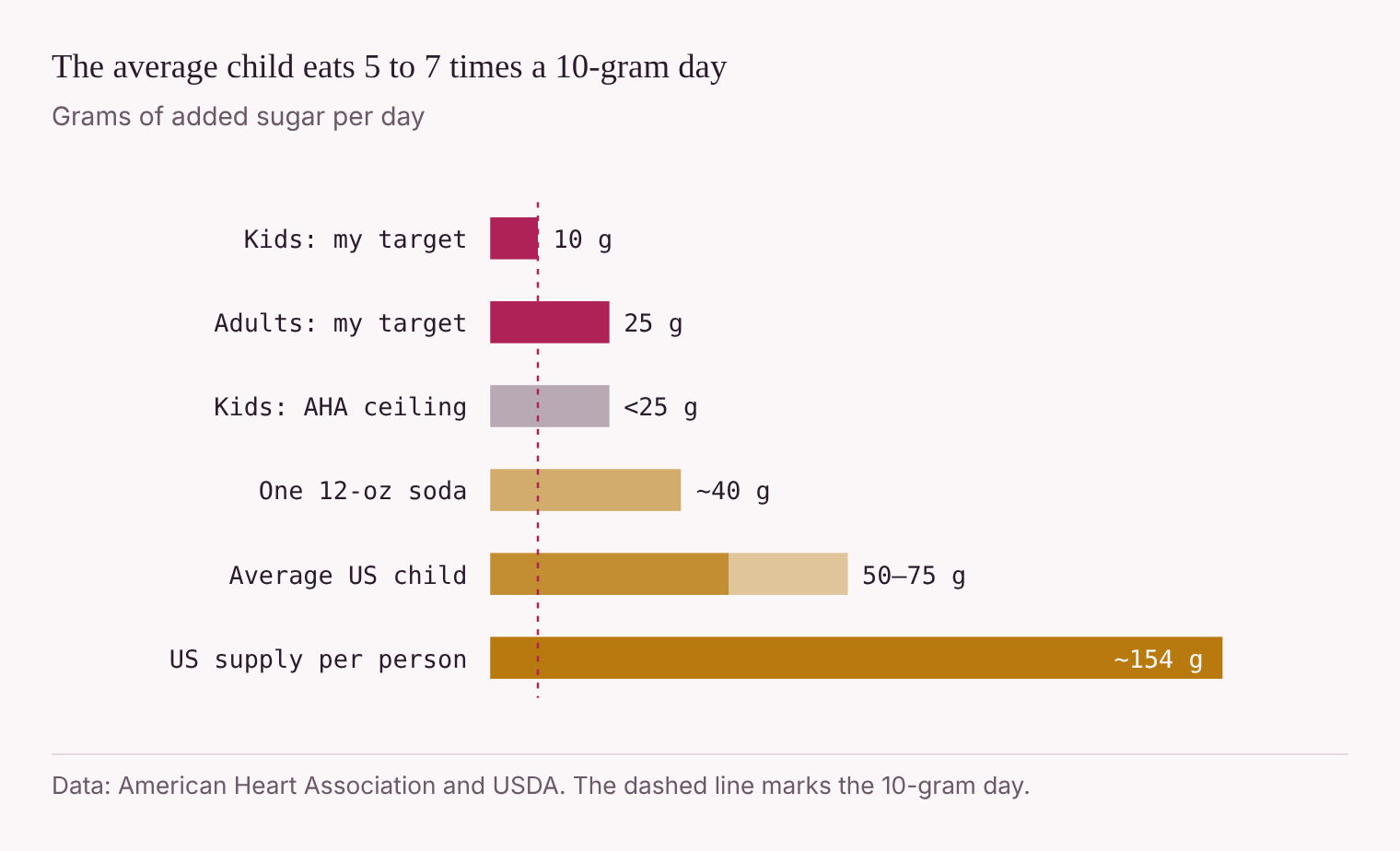
50–75 grams added sugar the average child eats a day
10 grams what I aim for with kids. Adults: 25 g
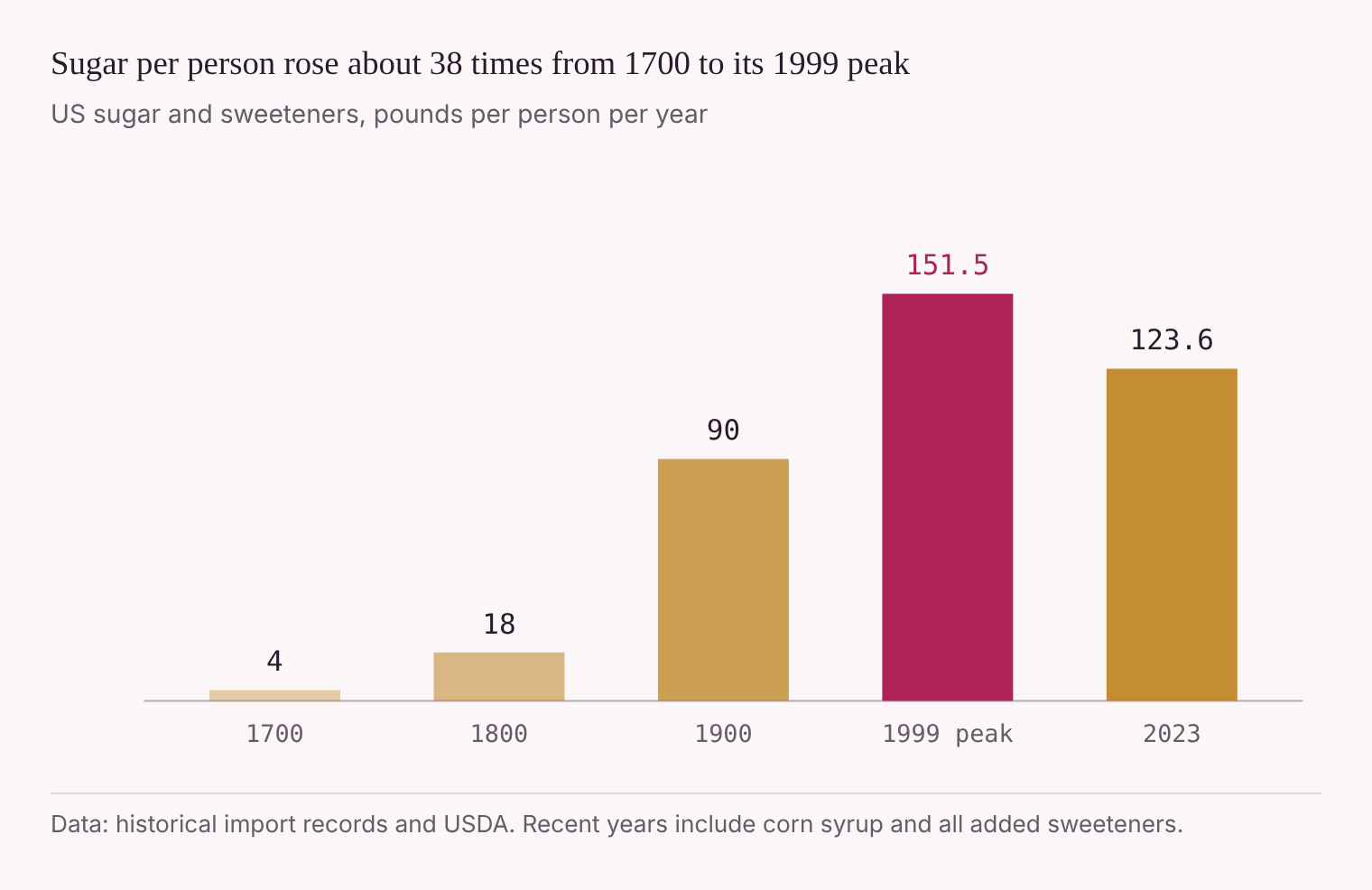
We eat a lot more sugar than we used to
Not long ago, sugar was a treat. A few pounds a year per person, if that. Today it's in bread, yogurt, ketchup, "healthy" granola bars and almost every drink marketed to kids.
The American Heart Association says kids should have under 25 grams of added sugar a day, and babies under 2 should have none. In my practice I aim lower: about 10 grams a day for kids and 25 grams for adults. Ten grams is about two and a half teaspoons. One juice box can blow through that before school starts.
The average child eats 5 to 7 times a 10-gram day
And ADHD keeps climbing
About 1 in 9 American kids has now been diagnosed with ADHD, a million more than in 2016. Some of that is better awareness. But here's a twist: sugar supply has actually dipped a bit since 1999, and ADHD kept going up anyway.
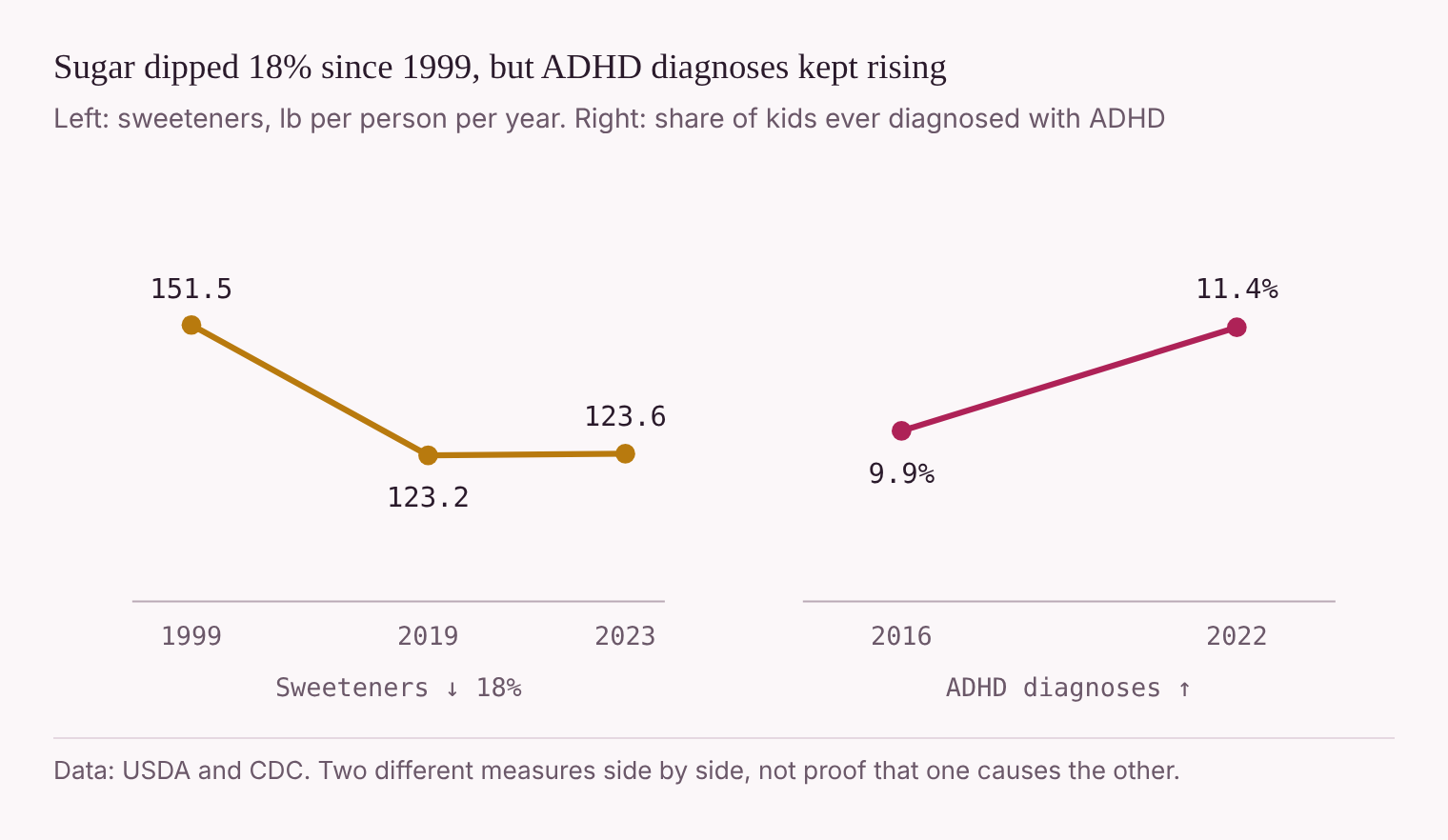
To me, that says table sugar isn't the real problem, instead it is the other high processed food and white carbs, such as white flour, chips and crackers, which turn into sugar in the body too. Add insulin resistance, poor sleep, screens, stress and a tired gut, and you get a body that's running hot, right into chronic inflammation. This is the driver of neuroinflammation.
The brain runs on energy
Dr. Chris Palmer, one of the leading voices at this week's summit, puts it simply in his book Brain Energy: mental health conditions, ADHD included, are problems with how the brain makes and uses energy (Palmer, 2022). When the tiny power plants in our cells, the mitochondria, are stressed by blood sugar swings and inflammation, the brain has a harder time focusing, calming down and staying steady.
Dr. Bruce Lipton adds a hopeful piece. His point is that genes aren't destiny: the environment we give our cells helps decide which genes turn on (Lipton, 2016). Food is part of that environment, every single day. A child may be born wired for ADHD, but what's on the plate may turn the volume up or down.
What a high-sugar day can feel like
Spike = Cereal, juice or a muffin floods the blood with sugar.
Crash = Blood sugar drops. Focus goes with it.
Stress hormones = The body pushes out adrenaline to recover. Hello, meltdown.
Cravings = The brain wants another quick hit, and the cycle repeats.
InflammationDay after day, the body stays on low-grade alert.
Is it an addiction?
Sugar lights up the same reward system in the brain that drugs do. ADHD brains tend to crave that quick reward more than most. So it's fair to wonder whether some of what we see is a brain chasing sugar, and sugar making that brain harder to settle.
I don't think ADHD is only a sugar addiction. ADHD is real, and it runs in families. But I do believe sugar and inflammation can make it much louder, and sometimes look like ADHD when something else is going on underneath.
The small symptoms that may be telling a bigger story
Here's what I really want parents to think about. Inflammation rarely shows up first as a diagnosis. It shows up as the little things we've learned to shrug off:
Chronic ear infections
Swollen tonsils or adenoids
Always-stuffy nose
Mouth breathing
Snoring or restless sleep
Dark circles under the eyes
Eczema or rashes
Frequent tummy aches
Each of these is the body saying it's inflamed or irritated. And some of them hit the brain directly. A child with big tonsils or a blocked nose may not breathe well at night. A child who doesn't sleep deeply can look a lot like a child with ADHD the next day: wiggly, distracted, emotional.
So I wonder: how often are we treating the ear, the nose, the skin and the behavior as separate problems, when they might be branches of the same tree? The tree of chronic inflammation.
Questions to sit with
I'm not going to give you a checklist. I'd rather you notice. Some questions to think about this week:
How many grams of added sugar did my child eat today? Was I surprised?
Does my child's mood or focus change an hour or two after sweets or snacks?
How many ear infections, rounds of antibiotics or stuffy-nose months has my child had?
Does my child snore, breathe through their mouth, or wake up tired?
What would change if I cut out just one sugary drink a day for two weeks?
Have I ever talked to our doctor about how these small symptoms might connect?
The big question
Is mental health more of a metabolic symptom, or is it chronic inflammation in the brain?
Maybe it's both, feeding each other. I don't think we have the full answer yet. But I know where I'd start looking: on the plate, and in the small signs our kids' bodies are already giving us.
Want help connecting the dots? My course walks parents through sugar, inflammation and the gut-brain connection in plain language, with simple steps for real families.
This post is for education, not medical advice. Please work with your child's doctor on any diagnosis, treatment or medication change.
References
Lipton, B. H. (2016). The biology of belief: Unleashing the power of consciousness, matter & miracles (10th anniversary ed.). Hay House.
Palmer, C. M. (2022). Brain energy: A revolutionary breakthrough in understanding mental health—and improving treatment for anxiety, depression, OCD, PTSD, and more. BenBella Books.
