
Why so many of us are exhausted, why our kids are too, and how to give ourselves permission to stop.

On my way back from visiting my parents, I re-read Madeline Levine's Ready or Not, because the themes keep coming up in my practice, friendships and family discussions. It also struck a chord in thinking about how I was raised after spending five days with my parents, alone without my kids. Life slowed down and I could truly appreciate my parents and how they raised me. As the sixth of eight kids, we had to be resourceful and independent. I see now why that was such a gift for my life and for the relationship I now have with my parents.
As I watch my own children grow, I keep wondering if we should just lay off them, the way my parents did. I keep coming back to it, because the pressure kids face now is real and it shows in the statistics. In her book, Levine describes patterns that have not eased. If anything, these patterns are heating up. The travel team starts younger, and has been bought by private equity to maximize competition. The tutoring starts earlier. The summer camp has to "build skills." The resume seems to start in kindergarten.
Nobody signed up for this on purpose. We each make small, loving decisions, one class, one team, one more lesson, and then look up to find a family calendar with no white space and a house full of tired people. My Husband and I call it The Enrichment Arms Race. (Truth be told, my husband coined this phrase and it sums up our modern dilema perfectly.)
Mostly, it puts words to the optimization and warfar-like tactics. I want all of us to have more agency to turn it off, and to take the side of our children's mental health, their need for autonomy, and the unstructured time they need to figure out who they are.
Parents are running on empty
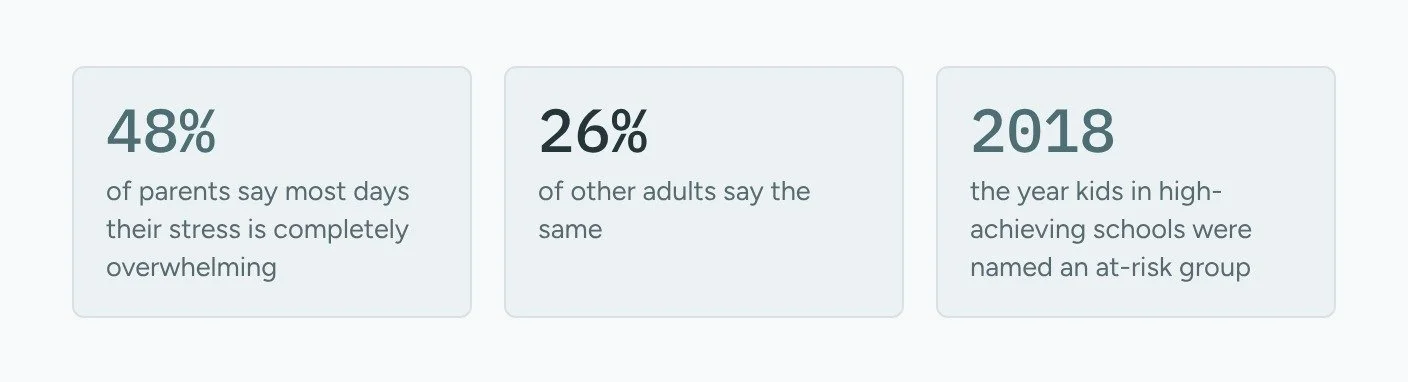
In 2024, the U.S. Surgeon General issued an advisory on parental stress. It reported that nearly half of parents feel completely overwhelmed by stress on most days, close to double the rate of other adults (Office of the U.S. Surgeon General, 2024). Time pressure, money worries, worry about kids' safety and mental health, and the feeling that we're never doing enough all pile on.
That last one matters. Much of our burnout isn't from parenting itself. It's from parenting as a sport or competition, where every free afternoon feels like ground lost to someone else's child.
What the “Arms Race” does to kids
I have mentioned this book before, but Jennifer Breheny Wallace in her book, Never Enough, gave this pressure a name: toxic achievement culture. She points to a 2018 report from the Robert Wood Johnson Foundation that added kids at high-achieving schools to its list of at-risk groups, alongside kids facing poverty, trauma and discrimination (Wallace, 2023). These kids show higher rates of anxiety, depression and substance use than we'd expect.
Wallace's answer is a concept called mattering. Kids thrive when they feel valued for who they are, not for what they produce, and when they feel they add value to the people around them. When a child's worth gets tied to grades, rankings and trophies, they learn that love is conditional on performance. That's a heavy thing to carry at eleven.
Always Busy or in the Car
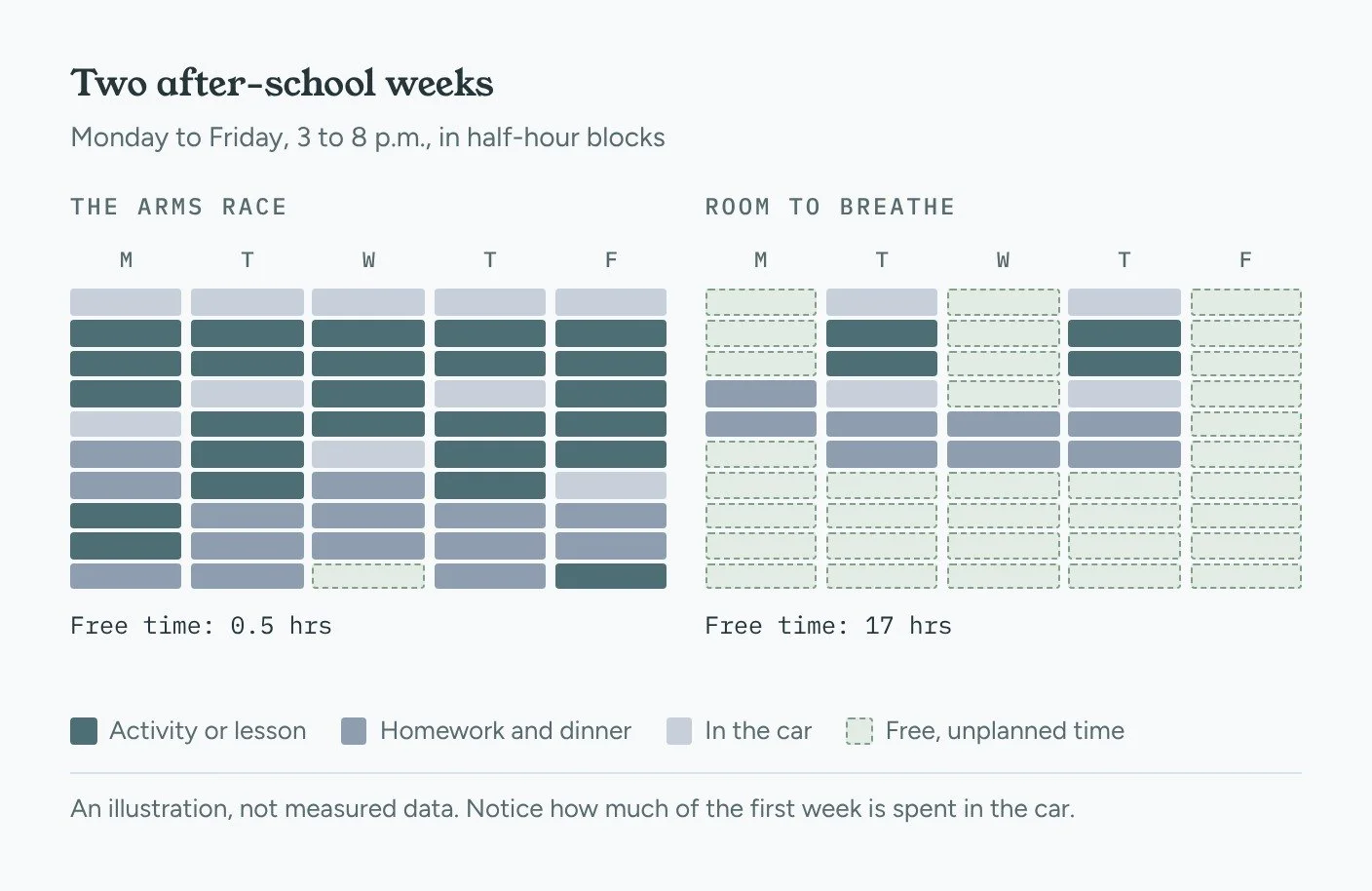
Below I outline a day-in-the-life of a modern school-aged kid. Most of their time is spent in activities, school or in the car on the way to these activities. When homework kicks in, they are doing that in the car or into the night hours when they should be sleeping. Where is the free time, or the time for family? We are leaving them in a malaise of peer orientation without personal time to think through the events of the day and consolidate what they are learning and experiencing.
The world our kids are actually headed into
Here's the part of Ready or Not that I find most useful. Levine argues that we're preparing our kids for a world that no longer exists. The old path, good grades to a good college to a steady career at a big company, is already breaking down. Our kids are walking into a future none of us can predict.
There's a term for that kind of world, and it comes from an unlikely place. In the late 1980s and early '90s, as the Cold War ended, the U.S. Army War College began describing the new global landscape as VUCA. My oldest brother went to the Army War college and retired as a colonel. He says to think of VUCA as an approach where no solution (or problem) is permenant. Flexibility is critical. I sought his thoughts, because this concept intrigues me and goes well with my title. Levine also thought so and discussed it in her book. She went far and wide to think about this probelm and found that business leaders of tech companies and the military were perhaps better resources to find solutions to this complex evironment rather than the standard set of reductionist psychologists. I would have to agree.
So what is VUCA. During the Cold War, the enemy was predictable. After it ended, the new world wasn't. The US Military brass developed the VUCA framework to teach developing leaders how to lead in a VUCA world. Notably, many business schools and leadership experts have also picked up the term, and it fits our children's future almost perfectly.
A VUCA world, and what it asks of our kids
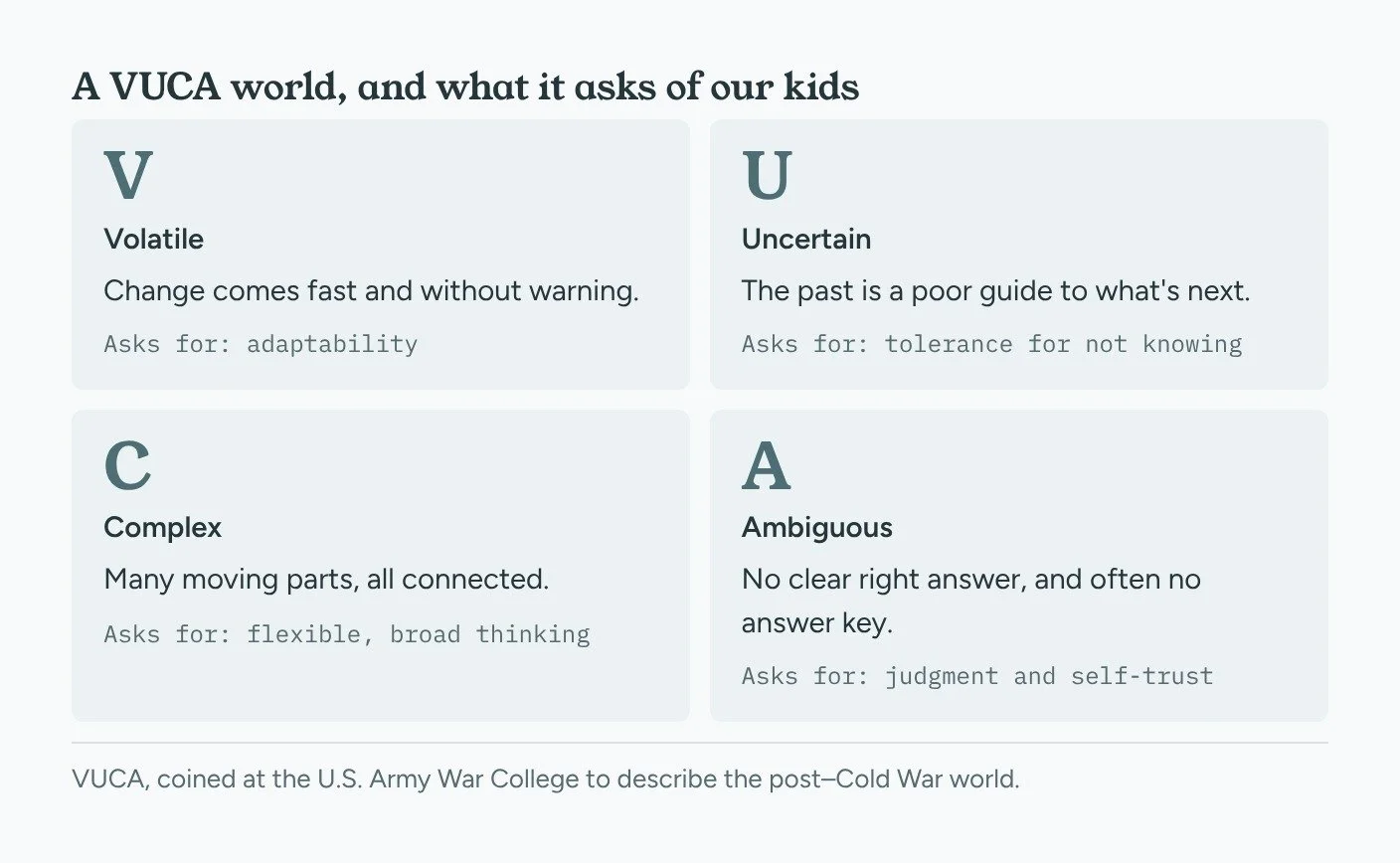
Now add “AI” or artificial intelligence. Our kids need adaptability, tolerance, flexible thinking, and self-trust more than ever. They will grow up with tools that can find, sort and summarize information faster than any person. Memorizing more facts, or drilling one narrow skill for years, may matter less than it ever has. What will matter is what a machine can't easily do: asking good questions, making connections across different fields, reading people, staying steady when the plan falls apart, and knowing what you value.
That's why I think less enrichment may actually be the better preparation. Breadth matters. Exposure matters. A child who has tried a lot of things, gotten bored, built a fort, quit something and started something else is building exactly the flexible mind this world will reward. A child who has been on one narrow track since age six may be very good at one thing and very scared of everything else.
“We keep adding more to protect our kids from an uncertain future. But uncertainty is the future. The best protection is a child who knows how to meet it.”
Six ways to step out of the race
These aren't rules. They're places to start, in roughly the order I'd take them.
Handle your own anxiety first
Levine is clear that a lot of overparenting is really parents managing their own fear. When we sign up for one more class, we're often soothing ourselves, not serving our child. Kids read our anxiety and absorb it. So before you change their schedule, notice what's driving yours. Talk it through with your partner, a friend or a therapist.
Try: Before adding an activity, ask yourself: "Is this for my child, or for my worry?"
Choose adaptability over achievement
Grades and trophies measure what a child did. Adaptability shapes who they can become. Praise effort, curiosity and how they bounce back, not just the result. Let them try things they may not be good at, and notice how they handle being a beginner.
Try: At dinner, ask "What did you try today?" instead of "How did you do?"
Protect free time
Unstructured time is where kids self-differentiate. It's where they get bored, follow their own interests and learn who they are when no one is directing them. Boredom isn't a problem to fix. It's the doorway to creativity. Guard free time the way you'd guard a doctor's appointment.
Try: Keep at least two weekday afternoons with nothing on the calendar at all.
Let them fail, small and safe
The forgotten homework, the lost game, the friendship that hits a rough patch: these are low-stakes rehearsals for the bigger falls of adult life. When we rescue every time, kids learn that they can't handle hard things. When we stay close but let it happen, they learn that they can.
Try: The next time they forget something, don't drive it to school. Help them plan for next time instead.
Build competence and independence
Real confidence comes from real competence. Cooking a meal, doing laundry, riding a bike to a friend's house, calling to make their own appointment. Every task a child can do on their own tells them, "I'm capable." That belief is worth more than another certificate on the wall.
Try: Pick one thing you still do for your child that they could learn to do this month.
Focus on what really makes people happy
When you strip away the noise, the research on a good life keeps landing in the same place: connection, purpose and self-mastery. Close relationships. Feeling that you matter and contribute. Getting better at something because you care about it, not because someone is keeping score. Wallace's idea of mattering fits right here. These are what we're really hoping to give our kids, and none of them can be bought as an enrichment program.
Try: Swap one weekly activity for something your family does together, or something your child does to help someone else.
Questions to sit with
If I'm honest, which of my child's activities are mostly about my own fear of them falling behind?
When did my child last have an afternoon with nothing planned? What did they do with it?
Does my child believe they're loved for who they are, or for what they achieve?
What's one thing I could stop doing for my child this month?
What would our week feel like if we dropped just one commitment?
The Big Question:
What if the most valuable thing we can give our kids is room?
Room to be bored, to fail, to wander and to find themselves. The arms race only keeps going because each of us keeps playing. We can each choose to step out, one free afternoon at a time.
Want help finding your family's pace? Get on my mailing list and keep and eye out for more workshops coming early next year. I am also working with some community organizations to support parents through anxiety, child development and raising resilient kids, in plain language with simple steps for real families.
This post is for education, not medical or mental health advice. If you're worried about your child's anxiety, mood or wellbeing, please talk with your pediatrician or a mental health professional.
References
Levine, M. (2020). Ready or not: Preparing our kids to thrive in an uncertain and rapidly changing world. Harper.
Office of the U.S. Surgeon General. (2024). Parents under pressure: The U.S. Surgeon General's advisory on the mental health and well-being of parents. U.S. Department of Health and Human Services.
Wallace, J. B. (2023). Never enough: When achievement culture becomes toxic—and what we can do about it. Portfolio.
